

Ventilation Strips
Basic Stuff
Ventilation is one of three important requirements for a healthy home.
We can provide you with a very simple solution to this. We call it the Thomson Ventilation System (TEVS).
It is a ventilation strip that fits into the soffit (eaves) just behind the gutter.
This allows air to flow through your roof cavity and remove the hot air and condensation.
This is called Passive Ventilation.
What that means is, it requires no power other than natural forces to remove the hot air.
All that is needed is the vent strip to be fitted on two opposing sides so that the air can flow in and out depending on which way the wind is blowing.

Technical Stuff
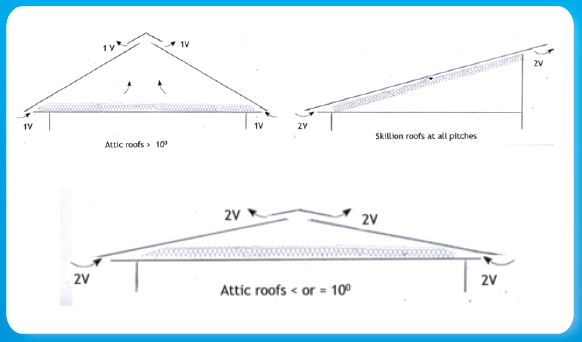
The broad parameters for ventilation design are between 1/150 and 1/300 of the flat area of the insulated roof. Low pitched roofs and those in sheltered areas may require more ventilation. The TEVS 50 has a NFA (Net Free Area) of 17,500 mm². The TEVS 25 has a NFA of 9,500 mm². The Ventilation Strips are made from Aluminium and can be powder coated to a nearest match to the Soffit colour. A permeable membrane can be fitted for marine environments and high wind zones.
A designated space is required to vent it outside the building, however for the stack effect to work a balance of intake (lower) vents and outlet (higher) vents is required. If the design is a monopitch this requires equal air inlet and outlet areas whereas a duo-pitch gable would require soffit vents on both sides totalling the area of the ridge outlet vent.
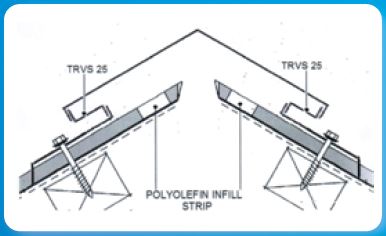
While a duo-pitch gable requires soffit vents on both sides it can have either a ridge vent or gable end vents. For skillion construction it is best to vent the barge on either side while a mono-pitch can either have soffit and ridge vents or barge vents on both sides up the slope.
It is important to retain a ventilation path and where possible allow a 20 mm air space either up and down or across the roof.
There are four very different situations attic, skillion, monpitch and duopitch and a different design type is required for each.
New building and retrofits also need a slightly different approach.